Solution
IPAWS Integration
FEMA-compatible mass notification equipment that integrates seamlessly with the Integrated Public Alert and Warning System — the federal backbone behind every WEA, EAS, and NOAA Weather Radio alert in the United States.
What Is a IPAWS Integration?
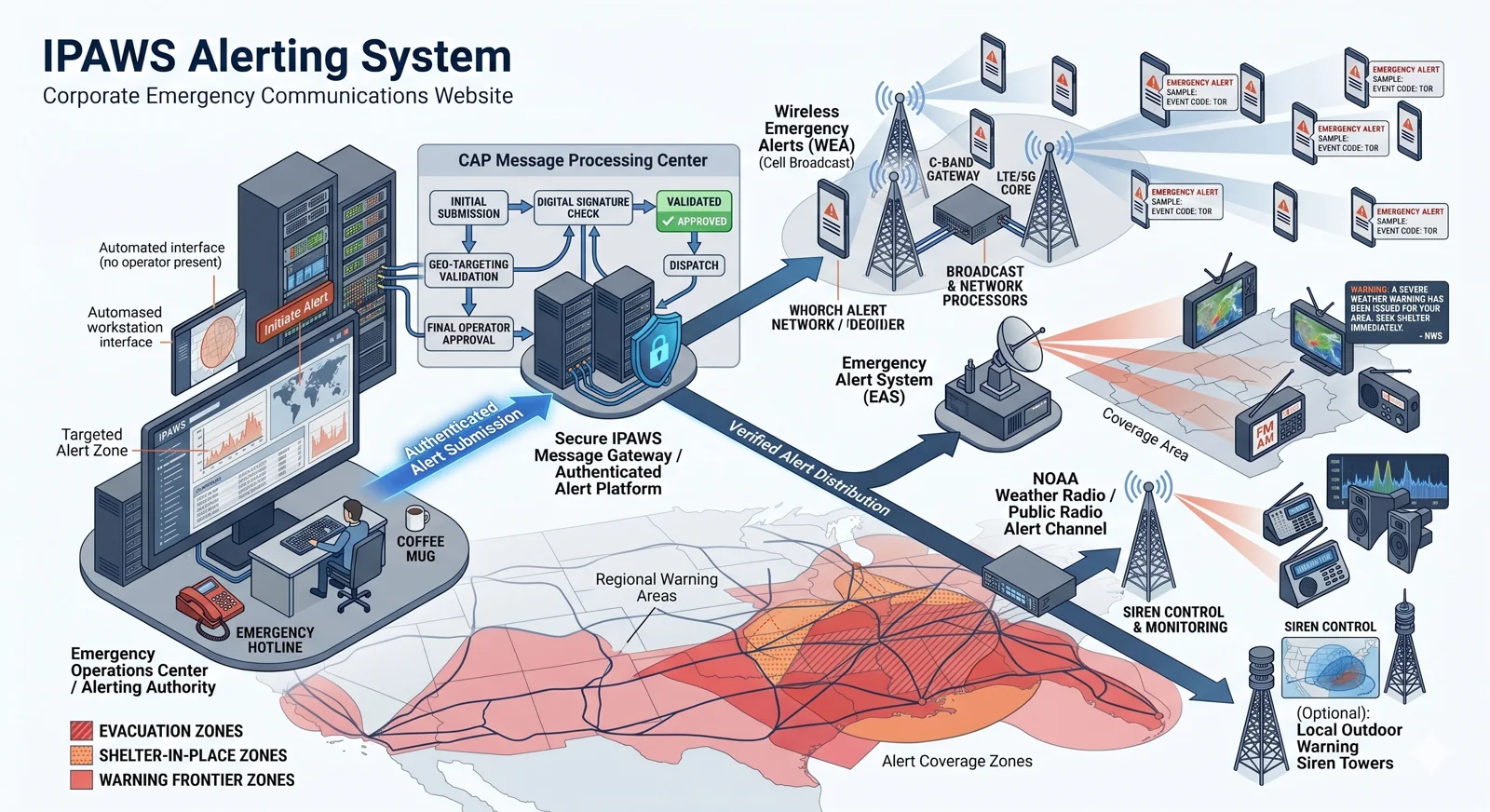
IPAWS — the Integrated Public Alert and Warning System — is the United States' national federal alerting platform, operated by FEMA. It is not a single channel but a hub-and-spoke architecture: alerts originate from any of more than 1,800 authorized alerting authorities (federal agencies, all 50 states and territories, thousands of municipalities, tribal governments, military installations, hospitals, and universities), pass through a centralized authentication gateway, and then distribute simultaneously to every public alert channel in the country.
At the core of IPAWS is IPAWS-OPEN (Open Platform for Emergency Networks), the federal message-routing service. An alerting authority drafts a single message in CAP (Common Alerting Protocol) format using IPAWS-compatible software. The message is digitally signed, geo-targeted to the affected area, and submitted to IPAWS-OPEN, which authenticates it and pushes it out across four primary distribution channels in parallel: Wireless Emergency Alerts (WEA) to mobile devices via cell broadcast; the Emergency Alert System (EAS) to AM/FM radio, satellite radio, broadcast television, cable, and satellite TV; NOAA Weather Radio for public weather radio receivers; and through open APIs to third-party systems including outdoor siren networks, IP loudspeakers, and digital signage.
For a hardware vendor — manufacturer of outdoor sirens, voice-broadcast loudspeakers, or mass notification controllers — IPAWS integration is not optional in the US public-safety market. State, local, and federal procurement specifications routinely require IPAWS compatibility, CAP-1.2 protocol support, and the ability to receive geo-targeted authenticated messages from the IPAWS gateway. A non-IPAWS-compatible product is excluded from most US civil-defense and DoD installation tenders before evaluation begins.
IPAWS integration is governed by published FEMA technical specifications including the IPAWS Profile of CAP, the EAS-CAP polling interface, and the WEA Service Specification. Vendors must implement these standards, validate against the IPAWS test environment (IPAWS Lab), and maintain conformance as FEMA evolves the platform. EnergoLab equipment is engineered against these specifications from the schematic stage so that integration with an existing IPAWS deployment is a configuration step, not a custom engineering project.
Because IPAWS itself is built to function during national emergencies, equipment that integrates with it must meet equivalent resilience standards: redundant network paths, cellular fallback when wired connectivity fails, solar and battery power that outlasts grid disruption, and continuous self-diagnostic reporting back to the local emergency operations center. A siren that is IPAWS-compatible on paper but offline during the next hurricane is not actually integrated.
Why You Cannot Operate Without One
IPAWS Compatibility Is a Procurement Gate, Not a Feature
US federal, state, and local procurement for mass notification routinely requires IPAWS compatibility as a binary qualifier. Equipment without it is excluded from evaluation. Choosing an IPAWS-integrated supplier is the difference between bidding and not bidding.
One Message, Every Channel
IPAWS is the only platform that turns one CAP-protocol alert into simultaneous distribution across mobile (WEA), broadcast (EAS), NOAA Weather Radio, and local sirens. Operators issue one message, and the federal gateway handles fan-out to every channel in their jurisdiction.
Authentication Builds Public Trust
Every IPAWS message is digitally signed and authenticated. The public can rely on alerts arriving through these channels; spoofed or unauthorized messages are blocked at the gateway. Hardware that originates IPAWS-bound messages must support the certificate infrastructure end-to-end.
Geo-Targeting Limits Alert Fatigue
IPAWS supports precise geo-targeting — alerts go only to the affected polygon, not the whole state. A fully integrated siren network respects geo-targeting at the device level, sounding only the towers in the alert zone instead of the whole inventory. Reducing false-positive activation builds long-term population responsiveness.
Multi-Channel Survives Single-Channel Failures
In a real emergency, mobile networks may be saturated, broadcast towers may be physically damaged, or weather radio may be the only channel reaching a remote area. IPAWS-integrated infrastructure ensures the message gets through on whichever channel is still operational — without the operator manually re-routing.
CAP Protocol Future-Proofs the Investment
CAP is an OASIS open standard, not a FEMA-proprietary format. An IPAWS-compatible siren or loudspeaker is also natively compatible with EU-Alert (Europe), Canada's NPAS, and other CAP-based national alerting systems being deployed worldwide. Integration is a global asset, not a US-only one.
How EnergoLab Solves It
EnergoLab designs and supplies mass notification hardware engineered against the FEMA IPAWS technical specifications: outdoor sirens, voice-broadcast loudspeakers, and local control units that receive authenticated CAP messages from IPAWS-OPEN, respect geo-targeting at the device level, and report status back through redundant channels. Equipment integrates with existing state and local IPAWS deployments as a configuration step, not custom engineering, and is built for the multi-decade service life that civil-defense procurement requires.
Real-World Impact
Daily Operation (Positive)
AMBER Alert National Distribution — 2013–present
Since the 2013 integration of AMBER Alerts into IPAWS, abducted-child notifications are distributed automatically to all WEA-capable mobile devices in the relevant geographic area. The US Department of Justice credits the WEA-based program with hundreds of recoveries — children located in time because a stranger nearby received an actionable alert with a description of the suspect's vehicle. IPAWS turned an opt-in subscription service into a default-on national capability.
Infrastructure Worked, Process Failed
Hawaii False Missile Alert — January 13, 2018
At 8:07 AM local time, a Hawaii Emergency Management Agency operator clicked the wrong drop-down menu item during a shift change. Within two minutes, IPAWS distributed “BALLISTIC MISSILE THREAT INBOUND TO HAWAII. SEEK IMMEDIATE SHELTER. THIS IS NOT A DRILL.” to every cell phone in the state, every TV channel, and every radio station. The message itself was an error — but the speed and reach demonstrated the underlying infrastructure works exactly as designed: a single click reaches an entire state population in under 120 seconds. Subsequent reform focused on UI safeguards, not on the alerting backbone.
Modern Multi-State Deployment
Hurricane Helene Response — Southeast US, September 2024
As Hurricane Helene moved inland through Georgia, Tennessee, North Carolina, and Virginia in late September 2024, state and local IPAWS-authorized authorities issued sustained evacuation orders, shelter-in-place messages, and post-storm public-health alerts to affected areas — geo-targeted to specific counties and watersheds. Many of those messages reached residents whose mobile networks were degraded but whose WEA cell-broadcast channel remained operational. The deployment illustrated IPAWS's design intent: when other channels degrade, the federally maintained alerting backbone keeps functioning.
Key Capabilities
CAP-1.2 Protocol Support
Full implementation of the IPAWS Profile of the Common Alerting Protocol — including digital signature validation, geo-polygon targeting, and event code handling.
IPAWS-OPEN Direct Interface
Direct connection to the federal IPAWS-OPEN gateway via authenticated TLS — no third-party middleware required for receiving WEA, EAS, and NWR messages.
Device-Level Geo-Targeting
Each siren respects the geo-polygon in the inbound CAP message, sounding only when in the alert zone — eliminating unnecessary activations.
Redundant Network Paths
Wired, cellular, and dedicated radio backhaul ensure the device receives IPAWS messages even when public networks are degraded or saturated.
Multi-Decade Service Life
Hardware engineered for the 20+ year procurement lifecycles typical of US civil-defense capital equipment, with documented obsolescence management.
Conformance Validated in IPAWS Lab
Equipment validated against the FEMA IPAWS test environment to confirm conformance with current and incoming specifications before field deployment.
Products Used in This Solution
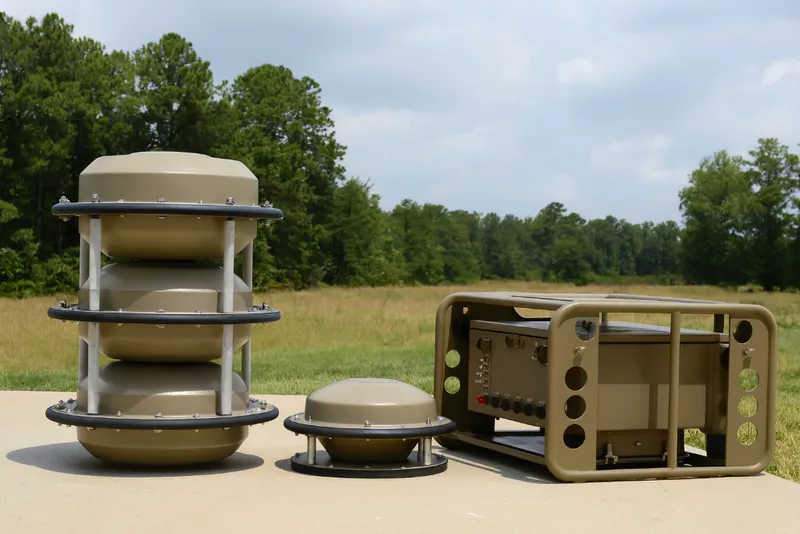
Mobile Alert System
A portable, robust alert system for rapid deployment in any environment. Ensures critical communication when it's needed most.
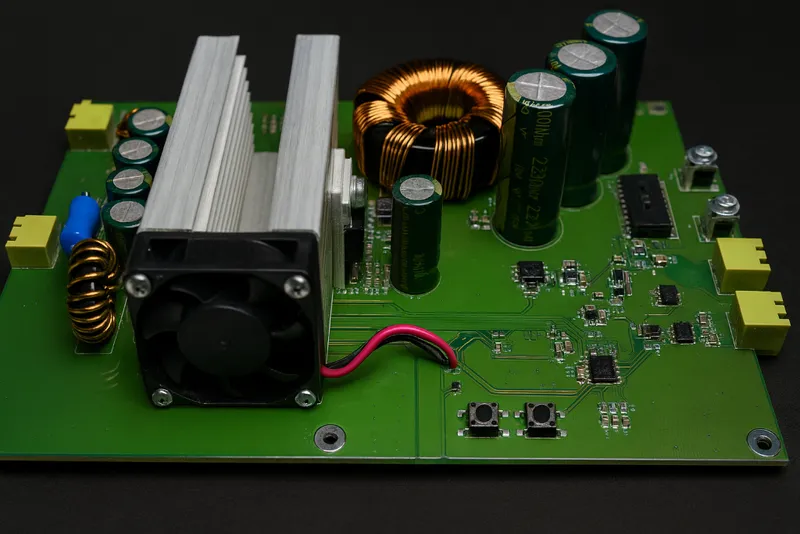
Amplifiers for Any Systems
High-power, efficient amplifiers designed to boost the range and clarity of alert and public address systems.
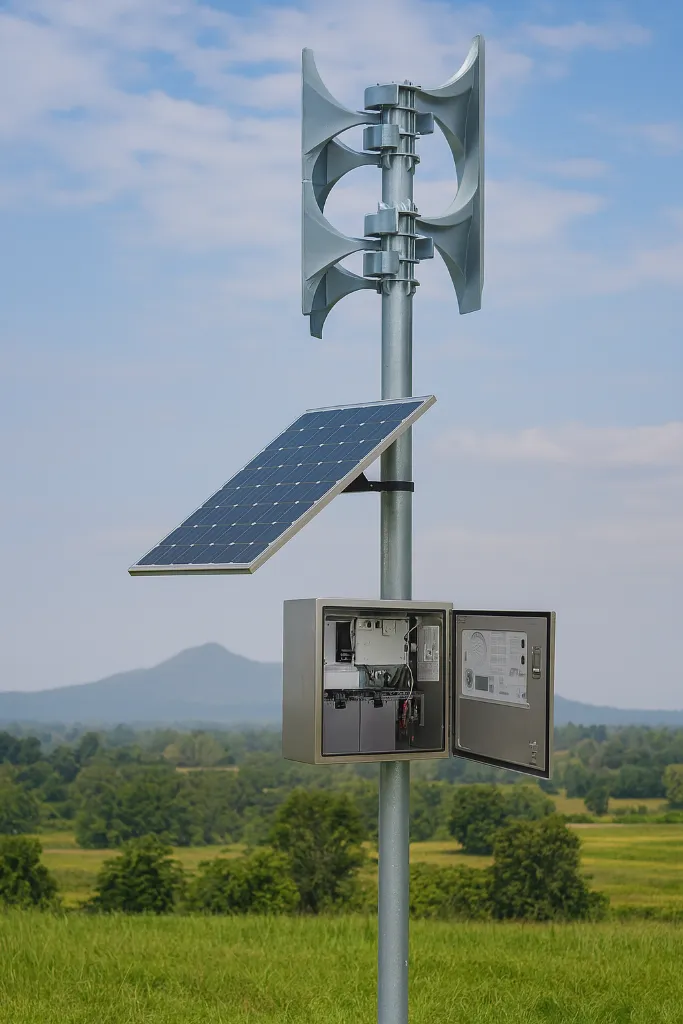
Electronic Siren with Cabinet
A powerful, solar-powered electronic siren complete with a weatherproof cabinet for long-range emergency alerts.
Typical Use Cases
- State and local emergency management agencies modernizing legacy siren networks to IPAWS
- Department of Defense installations integrating Giant Voice with national alerting
- Tribal governments deploying CAP-compliant outdoor warning
- Critical infrastructure operators (utilities, transit, healthcare) extending IPAWS reach to facility populations
Ready to Discuss Your Requirements?
Talk to our engineering team about your specific deployment scenario.