Solution
National Warning System
Centralized mass notification systems that alert an entire population in seconds — across cities, regions, or a whole country.
What Is a National Warning System?
A National Warning System (NWS) is the centralized, government-operated infrastructure that allows authorities to deliver an immediate, authoritative warning — and life-saving instructions — to an entire population in seconds. It is the single piece of public-safety infrastructure designed to operate at the scale of a country, on the timescale of an emergency.
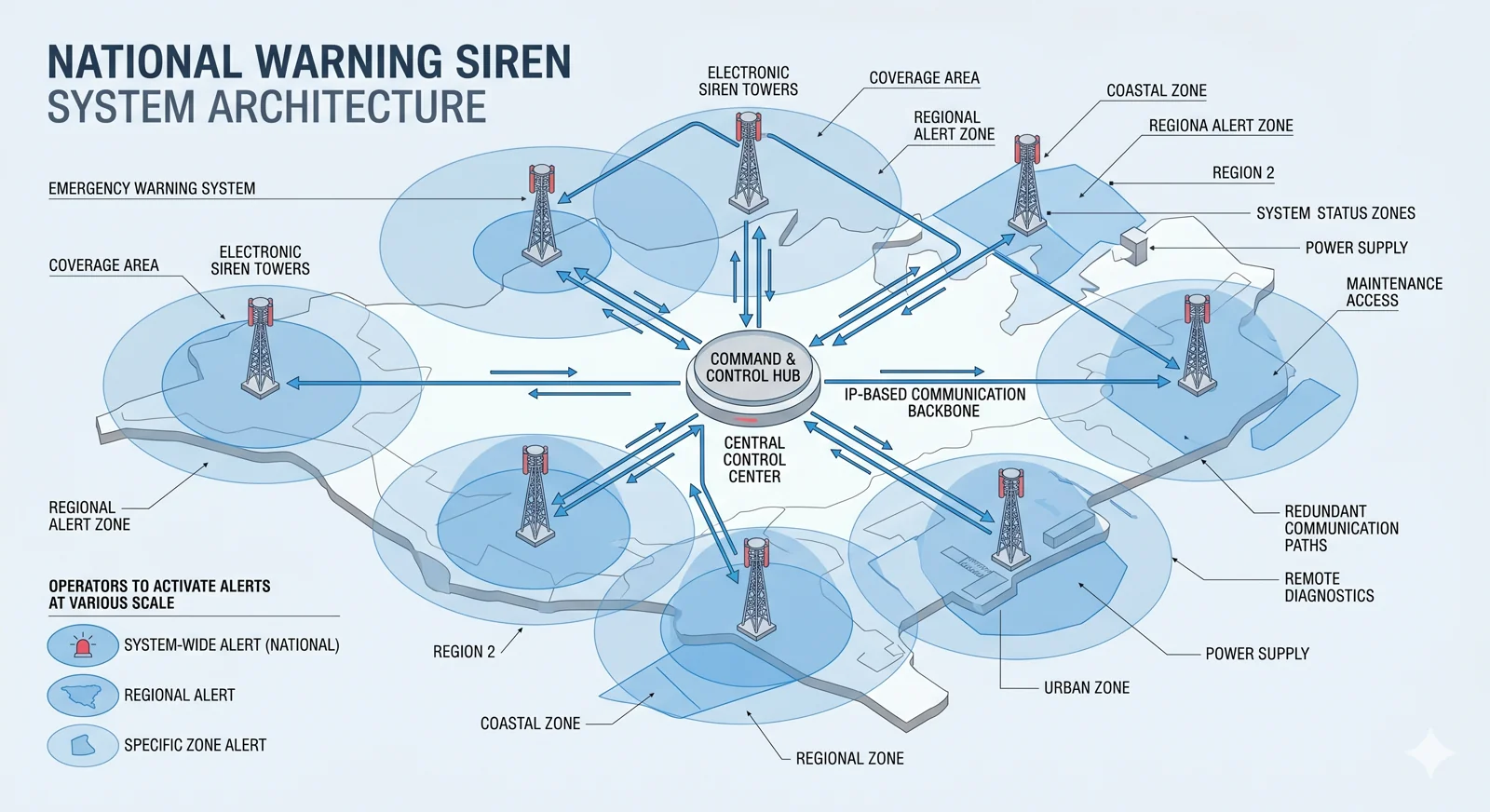
Architecturally, a national warning system is hierarchical. A national command center sits at the top, with regional and municipal centers below it, each capable of activating the network for its own jurisdiction or being overridden from above. At the edge sits a dense network of high-power outdoor electronic sirens, voice-broadcast loudspeakers, and connected devices — the units that physically reach people on streets, in fields, and in buildings without grid power.
A modern national warning system is multi-channel by design. Outdoor sirens cover people who are outside or in noisy environments. Voice broadcast turns a generic alarm into a specific instruction — “evacuate north,” “shelter in place,” “do not approach the coastline.” Cell-broadcast (WEA in the US, EU-Alert in Europe, MoWaS in Germany) reaches anyone with a cellular device in the affected area without requiring an app or subscription. Television and radio interruption (EAS in the US) reaches people indoors. Together, these channels achieve what no single channel can: blanket coverage of a population that includes the elderly, tourists, outdoor workers, drivers, and people without smartphones.
The system is also adversarially engineered. It must work when the grid is down, when cellular networks are saturated or destroyed, and when the people activating it are themselves under threat. That is why the backbone uses redundant communication links — IP, dedicated radio, and cellular — and why every siren in the field is solar- and battery-backed, capable of operating autonomously for days.
Why You Cannot Operate Without One
Time to Impact Is Measured in Minutes
Flash floods, tornadoes, ballistic threats, and chemical releases give a population minutes — sometimes seconds — to react. Manual procedures and ad-hoc social-media posts cannot meet that timeline. Only an automated, pre-authorized infrastructure activates fast enough to matter.
No Single Channel Reaches Everyone
Mobile alerts miss the elderly without smartphones, people who are asleep, outdoor workers, and tourists outside their home network. Television misses drivers. Radio misses people indoors. Only a multi-channel system blanket-covers a whole population.
Outdoor Sirens Are the Only Channel for People Outside
In tornadoes, tsunamis, and chemical releases, the people in greatest danger are outside — in fields, on streets, on beaches. They have no screen and often no phone in hand. Only a high-output siren, audible across kilometers, reaches them in time.
Cross-Jurisdiction Coordination
Wildfires cross counties; tsunamis hit entire coastlines; cross-border threats span nations. Without a national platform, alerts from different municipalities are fragmented, contradictory, and slow. A unified system speaks with one voice.
Authority and Trust
Populations only act on a warning when they trust its source. An alert from an official national channel mobilizes; a forwarded social-media post paralyzes. A national warning system carries the legal and institutional authority that turns a message into action.
It Survives the Disaster Itself
Earthquakes, hurricanes, and floods knock out grid power and cellular towers — exactly when the population most needs to be warned. A purpose-built warning system, with solar power and redundant radio links, keeps operating when the public networks fail.
How EnergoLab Solves It
EnergoLab designs and supplies end-to-end national warning systems built around a centralized command-and-control center, an IP-based communication backbone, and a network of high-power electronic sirens deployed across the protected territory. From a single operator console, authorized personnel can activate predefined alert scenarios — sirens, voice messages, evacuation instructions — for the whole country, a single region, or a specific zone. Every component is engineered in-house, so the system is tailored to the exact requirements of the customer's civil-defense protocol.
Real-World Impact
Natural Disaster
Elmira, NY Tornado — July 26, 2012
An EF-2 tornado damaged roughly 2,000 buildings in Elmira, New York. Wireless Emergency Alerts from the National Weather Service reached residents minutes before impact. Casualties were minimal because people moved to basements before the tornado struck — without the WEA infrastructure, the same event would have produced mass casualties.
Defense
Israel's Code Red (Tzeva Adom) Rocket Alert
Israel's nationwide Tzeva Adom system gives civilians 15 to 90 seconds of warning before rocket impact, broadcast through outdoor sirens, mobile alerts, and television. The system is credited with reducing rocket-attack casualties by an order of magnitude over the past two decades — turning potential mass-casualty events into largely survivable ones, every day.
Industrial Accident (No System in Place)
Beirut Port Explosion — August 4, 2020
The detonation of 2,750 tons of ammonium nitrate killed 218 people, injured over 7,000, and destroyed half of central Beirut. A fire had been burning in Warehouse 12 for roughly 20 minutes before the catastrophic blast — a window in which the surrounding port and adjacent city districts could have been evacuated. There was no early-warning infrastructure tied to the known hazardous-material storage on site. A national warning system integrated with industrial monitoring would have turned those 20 minutes into saved lives.
Key Capabilities
Country-Wide Coverage
Hierarchical architecture that scales from a single municipality to a nationwide network of thousands of acoustic units.
Centralized Command Center
One operator console controls every connected siren, with role-based access, audit logs, and predefined alert scenarios.
Multi-Channel Activation
Trigger sirens, voice broadcast, SMS, and third-party systems (cell-broadcast, IP speakers) from a single event.
Resilient Communication
Redundant IP, radio, and cellular links ensure the system stays online even if a primary channel fails.
Continuous Self-Diagnostics
Every siren reports its status in real time so failures are detected before the next emergency.
Built for Defense Standards
Ruggedized hardware engineered for outdoor deployment, extreme temperatures, and 20+ years of service life.
Products Used in This Solution
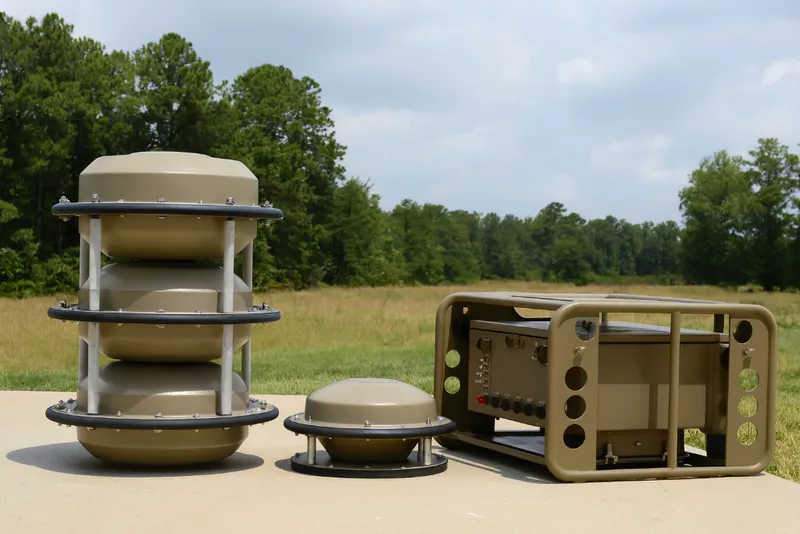
Mobile Alert System
A portable, robust alert system for rapid deployment in any environment. Ensures critical communication when it's needed most.

Amplifiers for Any Systems
High-power, efficient amplifiers designed to boost the range and clarity of alert and public address systems.
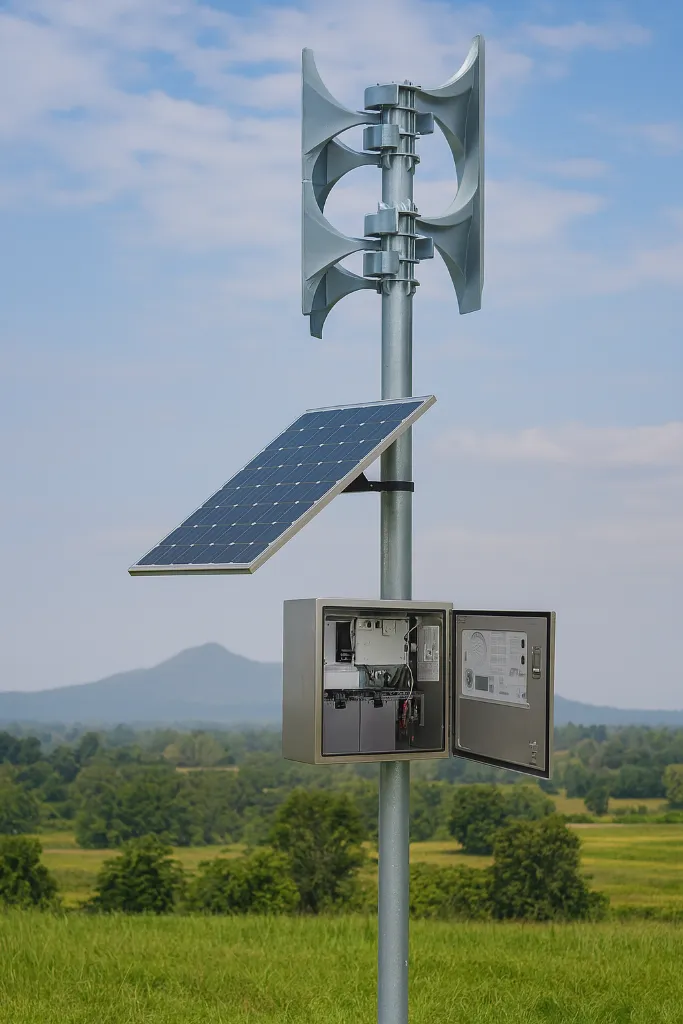
Electronic Siren with Cabinet
A powerful, solar-powered electronic siren complete with a weatherproof cabinet for long-range emergency alerts.
Typical Use Cases
- Civil defense agencies coordinating nationwide population alerts
- Ministries of interior modernizing legacy siren networks
- Border regions requiring rapid cross-municipality alerting
- Critical-infrastructure operators integrating into national alert protocols
Ready to Discuss Your Requirements?
Talk to our engineering team about your specific deployment scenario.